1. It took him eight years and more than 10,000 pea plants to discover the laws of inheritance.
Gregor Mendel
2. Even though he added an extra strand to the structure of DNA, he ultimately won two Nobel Prizes: the Nobel Prize in Chemistry and the Nobel Peace Prize.
Friedrich Meischer
3. The scientist won two Nobel Prizes in Chemistry: one for his work on the structure of protein and another for work on the determination of base sequences in nucleic acids.
Carl Correns
4. These scientists used a common kitchen appliance to help show that phage DNA carries instructions to make new phage particles. Thinking of making a milkshake?
Hugode Vries and Erichuon Tschermak
5. Next time you're munching away at the moves, think of this Nobel-Prize winning scientist who figured out the process of transportation in corn chromosomes.
Thomas Morgan
6. When did Drs. Watson, Crick and Wilkins receive the Nobel Prize in Physiology or Medicine for solving the structure of DNA?
1962
7. This scientist found that some viruses have an RNA-dependent DNA polymerase that was later named "reverse transcriptase." He was one of three who shared in the 1975 Nobel Prize in Physiology or Medicine.
Fredrick Sanger
8. Even though he had worked on a potato farm, Steve Fodor's work led to the development of this kind of chip (you can't eat it!)
Genechip
9. J. Craig Venters company, Celera Genomics, worked on this very important project.
EST method of finding genes
10. Meselson and Stahl invented this new technique in their quest to prove that DNA replication is semi-conservative
Density giodient center function
11. In which year was the first test-tube baby born?
1978
12. I first isolated DNA using pus collected from bandages at a local hospital. Since white blood cells are a major component of pus, they were my source of DNA. Yuck!
Fredrich Miescher
13. The "fly room" at Columbia University was established through my efforts. Imagine working in a room filled with bottle after bottle of fruit flies!
Thomas Morgan
14. We worked together to demonstrate how genes work during development to change egg cell into a complex organism. Follow our experiment and find out what the names of the stages are that a fruit fly goes through when maturing from a fertilized egg to an adult.
Eric Wieschams & Christane Nusslen
15. I showed that RNA could act as its own catalyst. Because of my work, it is no longer correct to state, "all enzymes are proteins".
Thomas Cech
Wednesday, March 12, 2014

Wednesday, February 26, 2014
CREATE-A-BABY REVIEW
1.
Chromosome- a threadlike structure of nucleic acids and protein found in the nucleus of most living cells, carrying genetic information in the form of genes.
Codominant- a phenomenon in which a single gene has more than one dominant allele.
Diploid- (of a cell or nucleus) containing two complete sets of chromosomes, one from each parent
Haploid- (of a cell or nucleus) having a single set of unpaired chromosomes.
Meiosis- a type of cell division that results in four daughter cells each with half the number of chromosomes of the parent cell, as in the production of gametes and plant spores
Multigenic- an inherited characteristic that is specified by a combination of multiple genes
Recombination- process of recombining things
2. What was the probability that you and your partner would produce a boy? A girl? Explain.
It was a 50-50 chance because you can only get a boy or a girl. You cant get any other baby unless there is a defect in the baby's structure.
3. Explain how it is possible for your baby to have a visible trait that neither you nor your partner have.
That is only possible if the recessive trait dominates the dominant trait or if both partners have the same recessive trait
4. If you and your partner repeated this exercise and produced another imaginary baby, do you think it would look just the same as the one you produced already? Explain.
I dont think it would look exactly the same but its possible that it might have the same features as the other because its coming from the same two partners. So the possibilities will always be different with some similarities.
5. A woman who is heterozygous for the chin dimple trait marries a man without a chin dimple. What are the possible genotypes and phenotypes of their children?
possible genotypes: nn, Nn possible phenotypes: Dimple, no dimple
6. What is the probability that the man and woman discussed in the preceding paragraph will have a baby with a chin dimple?
There is a 50/50 chance the baby with either have or not have a chin dimple.
7. A man and a woman who are both heterozygous for two traits, the cheek dimple and the chin dimple traits, get married. What is the probability that they will have a baby that has cheek dimples, but not a chin dimple? there is 50% chance the baby will have a cheek dimple and a 50% chance it will have a chin dimple
8. What is the probability that a man with dark blonde hair and a woman with red hair will have a baby with brown hair? there is a good chance that the baby will have brown hair about 75% chance.
Link to CREATE-A-BABY-CHART----------> https://docs.google.com/spreadsheet/ccc?key=0Are7fmaiSrKidFZNT2RhMHNSYXlQYndDVkFvUEJWUXc#gid=0
Tuesday, February 25, 2014
6 Box Graphic Organizer w/ Central Theme
With this graphic organizer, we all went over genes and which alleles were which, for example: Aa, AA, aa, that kind of thing. Like, the big 'A' is representing the dominant trait, whereas, the little 'a' is representing the recessive trait. Also a gene is one place or location on a chromosome.
here is the link to my graphic organizer w/ central theme.
https://docs.google.com/a/lajunta.k12.co.us/drawings/d/1C0M3jGcgGLqPFsvlJMSggmDzQfIBXwhs5dgY74_RqfQ/edit
here is the link to my graphic organizer w/ central theme.
https://docs.google.com/a/lajunta.k12.co.us/drawings/d/1C0M3jGcgGLqPFsvlJMSggmDzQfIBXwhs5dgY74_RqfQ/edit
Friday, January 24, 2014
Cell Cycle
In biology I just learned about the cell cycle and how it all works and its pretty neat! Theres a whole process that each cell goes through individually just to make another copy of itself and its a repeating thing that happens with cells. In these labs/activities, I figured out what processes did what, and what the stages actually look like and I gotta say, its more interesting than I thought it would be! I really thinks its cool.
100%

1. What percent of cells were in interphase?
55.56%
2. What percent were in mitosis?100%
3. Which phase of mitosis takes the longest?
Interphase.
4. During which stage is the nucleolus visible as a dark spot?
Prophase.
5. How can you recognize a cell in metaphase?
When the cells are splitting apart.
6. How might you figure out how long (in minutes and/or seconds) each phase of the cell cycle takes based on the data from these onion root cells? Explain your logic and show your calculations and results below.
Interphase
|
Prophase
|
Metaphase
|
Anaphase
|
Telophase
|
Total
| |
number of cells
|
20
|
10
|
3
|
2
|
1
|
36
|
percent of cells
|
55%
|
27%
|
9%
|
6%
|
3%
|
100%
|
7. Produce a pie chart in Create-a-Graph that shows the relative lengths of each stage of the cell cycle in these cells including interphase and each stage of mitosis. You can embed the graph here or directly in your blog.
Friday, December 13, 2013
Enzyme Lab
We recently did a lab where we(Lauren, Damon, and I) tested enzyme activity at different factors to see what changes we can identify. I thought that when we added more enzymes it would make the solution, which was Hydrogen Peroxide diluted in Water, have more of a reaction. The reaction was the pressure sensor plug popping off. That was the first test we did.
The second test we did was with the yeast. With this test I thought that the more yeast we put in, the quicker we would have the reaction of the sensor plug popping off.
After the plug popped off with the yeast test, the yeast went everywhere!! It was pretty intense actually! It scared me! The plug popped off with both tests at 30, 40, and 50 drops. All of the test tubes that we had, had the plug pop off!!
When we added temperature to the test tubes I thought that it would slow down the reaction a little bit.. It ended up being that we had to have the perfect temperature to have a reaction because it being too hot slowed it down and it being too cold also slowed it down a lot. This graph is Test #1.
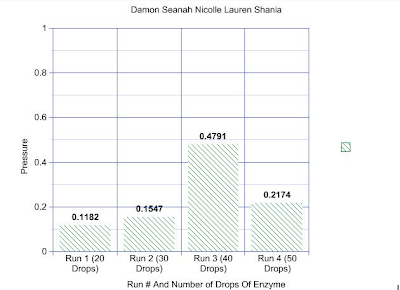


The second test we did was with the yeast. With this test I thought that the more yeast we put in, the quicker we would have the reaction of the sensor plug popping off.
After the plug popped off with the yeast test, the yeast went everywhere!! It was pretty intense actually! It scared me! The plug popped off with both tests at 30, 40, and 50 drops. All of the test tubes that we had, had the plug pop off!!
When we added temperature to the test tubes I thought that it would slow down the reaction a little bit.. It ended up being that we had to have the perfect temperature to have a reaction because it being too hot slowed it down and it being too cold also slowed it down a lot. This graph is Test #1.

This graph is for Test #2

This is the graph for test #3

Friday, November 22, 2013
PKU
Metabolic disorders are genetic diseases that affect the body's ability to perform its normal chemical reactions. Many metabolic disorders result from enzyme defects. Recall that a metabolic pathway is a stepwise sequence of enzyme-mediated reactions. If one enzyme in a metabolic pathway is defective, that enzyme's substrate may accumulate and the pathway may not be completed. This may result in a buildup of harmful substances or a shortage of required molecules.
Some Answered Questions on PKU---v
1. What enzyme is most commonly defective in people with phenylketonuria?
A: The PAH (phenylalanine hydroxylase) enzyme. It’s produced in the liver.
2. What reaction does this enzyme catalyze? (What is the substrate and what product is produced?)
A: A substrate is a molecule upon which an enzyme acts. the substrate bonds with the enzyme active site, an enzyme-substrate complex is formed.
3. Describe the symptoms of phenylketonuria.
A: Bahavioral/Social Problems, Hyperactivity, Mental Retardation, Small Head SIze, Etc..
4. What causes the symptoms of PKU, the lack of a substance or the buildup of one? Explain.
A: The build up of a substance, can cause the a young child who may seem normal for the first few months of life but if it goes untreated it can cause many problems
5. How common is phenylketonuria? How is it treated?
A: The occurrence of PKU varies among ethnic groups and geographic regions worldwide. Treatment involves a diet that is extremely low in phenylalanine, particularly when the child is growing. The diet must be strictly followed.
It was very informational and i learned a lot about what phenylketonuria is and how it affects the body, and how people would be able to treat it.
Tuesday, November 19, 2013
Microscope quiz
In using the microscope, I looked at a couple slides and the one that I found most interesting was the Leaf and stem slide. When I got the focus just right, I noticed that it was a very green, blue, pink, and purple color. It was very interesting and pretty I liked it!
As I zoomed in closer and closer I started to see the outline of the cells, then the cell membrane of the plant and a little bit of what was inside of each cell. It really makes me wonder like what everything looks like when you're in that deep with a cell.
Here are some pictures of the slide that I looked at through the microscope.
Zoom at : lowest

Zoom at: a bit higher

Zoom at: second highest

As I zoomed in closer and closer I started to see the outline of the cells, then the cell membrane of the plant and a little bit of what was inside of each cell. It really makes me wonder like what everything looks like when you're in that deep with a cell.
Here are some pictures of the slide that I looked at through the microscope.
Zoom at : lowest

Zoom at: a bit higher

Zoom at: second highest

Subscribe to:
Posts (Atom)